Projextly
A full-stack project marketplace and mentorship platform — built as a Turborepo monorepo with a Next.js web app, a dedicated admin panel, and an MDX documentation site.
Overview
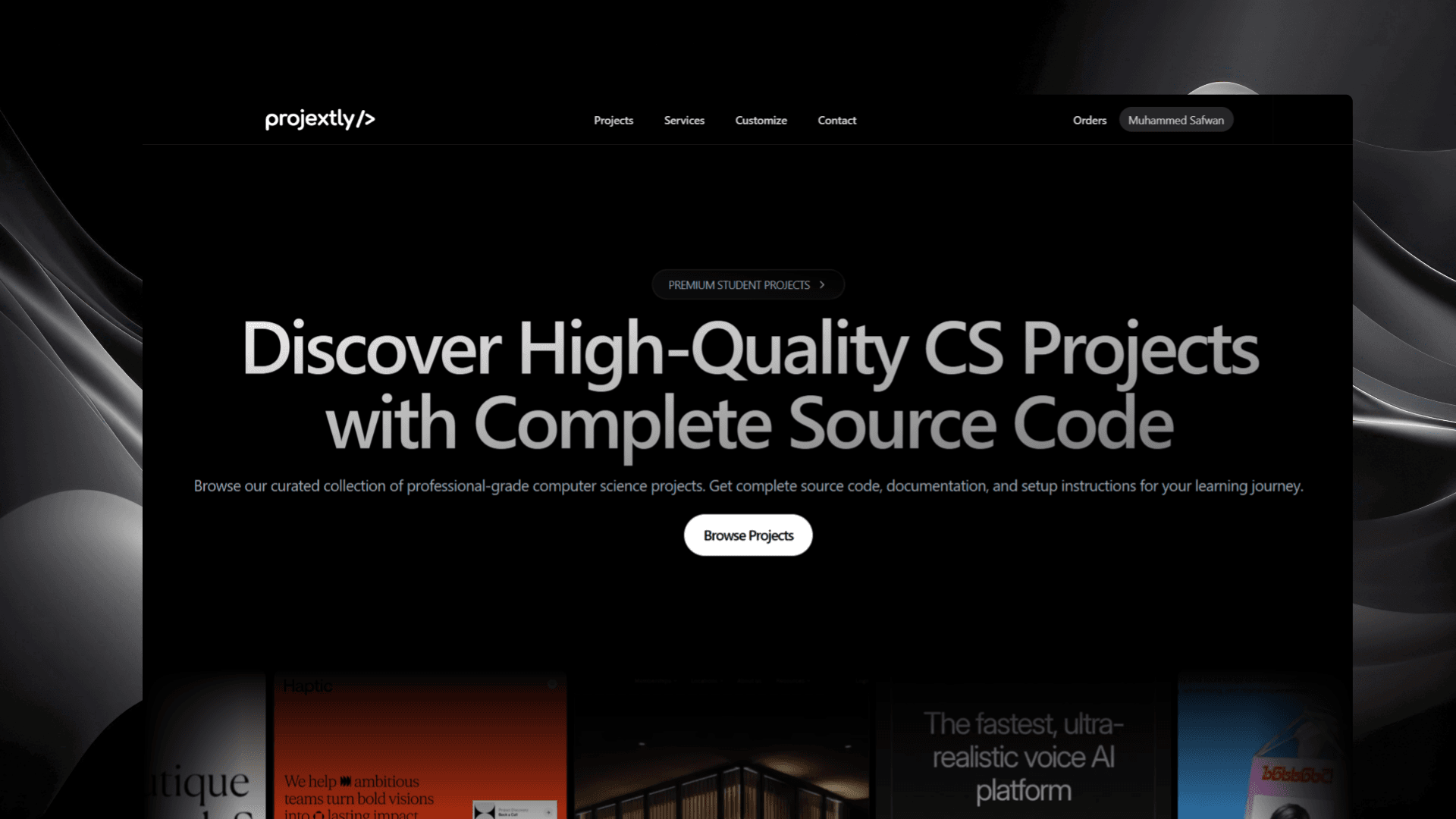
Projextly is a full-stack project marketplace — a place where developers can browse, purchase, and download source-code projects, and where clients can submit custom project requests. The platform is split across three applications that share a common library, database layer, UI kit, and type definitions inside a single Turborepo monorepo.
Architecture
The repository follows a monorepo layout managed by Turborepo and pnpm workspaces:
Turborepo handles task pipelines — build waits for ^build across all packages, environment variables are declared once in turbo.json, and remote caching via Vercel makes CI fast across the team.
Key Features
Marketplace (web app)
- Browse and search projects by category, tech stack, and features
- Purchase paid projects via Razorpay payment integration
- Download free or purchased projects — files served from Cloudinary with signed, time-limited URLs
- Submit custom project requests with deadline, budget, tech stack, and reference links
- Google OAuth + email/password authentication via NextAuth
Admin Panel
- Protected dashboard accessible to users with the
adminrole only - Full CRUD for projects, categories, tech stacks, and features, each with paginated server actions
- Project editor split into focused sections: Basic Info, Features & Tech Stacks, Pages, Links & Resources (file upload or URL), and Pricing — all validated with Zod via
ZProjectInput - Custom project request management with status workflow (pending → reviewing → approved → rejected → completed) and an inline detail modal
- User management with role-based filtering
- Overview page with aggregate stats (total users, projects, revenue, downloads)
- File uploads routed through a signed-URL endpoint to Cloudinary (with local fallback for development)
Documentation Site
- MDX-powered docs app with full-text search, dark mode, and custom typography
- Shared component library (
@/components/mdx) withMdxImage,ResponsiveVideo,CodeGroup, andNotecomponents - Automatic sitemap generation via
next-sitemap
Tech Stack
| Layer | Choice | Why |
|---|---|---|
| Monorepo | Turborepo + pnpm workspaces | Incremental builds, shared packages, remote cache |
| Framework | Next.js 15 (App Router) | Server Actions, streaming, image optimisation |
| Language | TypeScript | End-to-end type safety shared across all apps |
| Database | PostgreSQL + Prisma | Type-safe queries, migrations, shared schema package |
| Auth | NextAuth v4 | Google OAuth + credentials, session-based role checks |
| Styling | Tailwind CSS | Shared config across all three apps |
| Storage | Cloudinary + local fallback | Signed uploads, CDN delivery, download attachments |
| Payments | Razorpay | INR-native payment gateway |
| Docs | @next/mdx + Shiki | Syntax-highlighted MDX with remark/rehype plugins |
| Monitoring | Sentry + Vercel Speed Insights | Error tracking and core web vitals |
Implementation Highlights
Server Actions as the API Layer
Rather than maintaining a separate REST API, the admin app uses Next.js Server Actions for every mutation. Each action validates the session with getServerSession, throws a typed AuthorizationError if the user isn't authenticated, and delegates to a service function in @projectmentors/lib. This keeps the surface area small — no separate route handlers, no client-side fetch boilerplate, and full type inference from server to client.
Zod-Validated Project Editor
The ProjectEditor component uses a single ZProjectInput Zod schema (defined in @projectmentors/types) to validate the entire form. On submission, ZProjectInput.parse() runs against the assembled payload, maps every ZodError issue to a fieldErrors state object, and surfaces the first three errors as toasts. Individual fields validate on change via ZProjectInput.shape[field].parse() — giving instant inline feedback without a form library.
Optimistic UI with useTransition
CRUD lists (categories, features, tech stacks) wrap mutations in useTransition and update local state before the server confirms. Deletes filter the local array immediately; creates prepend the returned record. The UI never blocks on a network round-trip for simple operations.
Signed URL Storage Architecture
File uploads follow a two-step flow: the client requests a signed URL from /api/v1/storage (which calls Cloudinary's upload API), uploads directly from the browser to the CDN, and saves the resulting URL to the database. Downloads are served through /storage/[accessType]/[fileName] which generates a short-lived signed Cloudinary URL with a fl_attachment transform, ensuring files cannot be hotlinked.
Collapsible Navigation with Persisted State
The admin sidebar (MainNavigation) stores its collapsed/expanded state in localStorage, restored on mount via a useEffect. Text labels fade in/out with a 150ms setTimeout offset to avoid layout jumps during the CSS width transition. Tooltips replace labels when collapsed, built on top of @projectmentors/ui/Tooltip.
Challenges
Shared package boundaries — Getting TypeScript paths, Tailwind content globs, and Next.js transpilePackages aligned across three apps and six packages required careful configuration. The solution was a set of base @projectmentors/config-* packages (TypeScript, ESLint, Tailwind) that each app extends, with minimal local overrides.
Hydration in the rich-text editor — The Editor component accepts either raw Markdown or HTML (from the database). On initial render, Markdown is converted to HTML via markdown-it before being passed to the editor. Without a stable key, React hydration mismatched between the server (which renders nothing) and the client. A key prop derived from formData.description and a firstRender gate solved the mismatch at the cost of a deliberate re-mount.
Cloudinary download filenames — By default, Cloudinary's CDN returns files with the storage UUID as the filename. The download route extracts the original base name from the path, sanitises it to alphanumeric and hyphens, and injects it as a fl_attachment:<safeTitle> URL transform — so buyers receive a file named react-dashboard.zip instead of v1_abc123xyz.zip.
What I Learned
- Turborepo's
dependsOn: ["^build"]model forces you to think about package dependency graphs explicitly — and once you do, incremental builds become significantly faster. - Zod schemas are most powerful when they live in a shared
typespackage: validation runs in the browser (instant feedback), on the server (action safety), and in tests, all from the same source. - Server Actions reduce the amount of client-side state you need dramatically — when a mutation returns the updated record, you can replace the local array entry directly rather than refetching.